
What Is an AI Execution Platform? The Definitive Guide (2026)
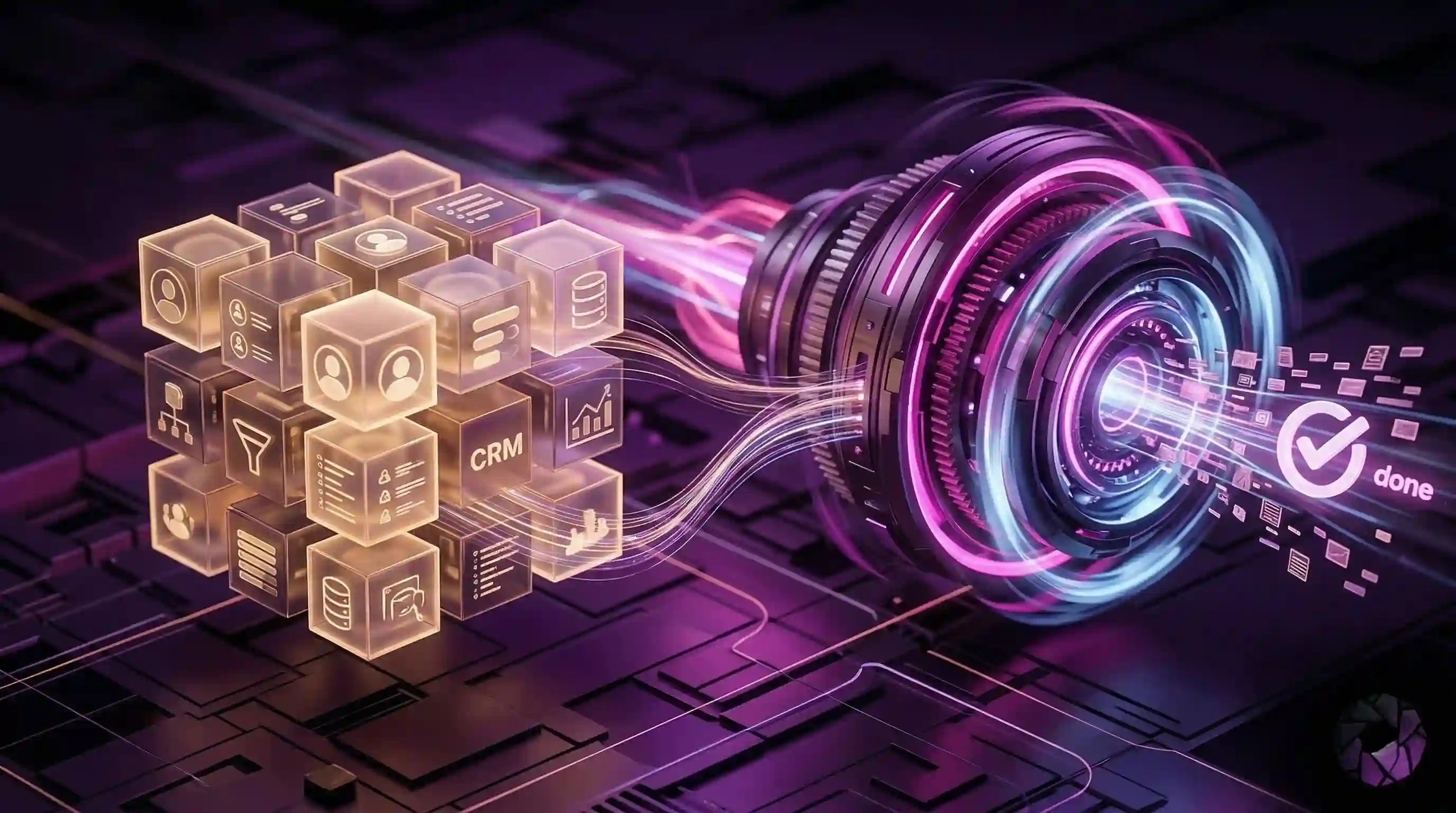
The term "AI execution platform" is appearing in more business conversations, product descriptions, and technical evaluations. Unlike many technology terms, this one describes something specific — and the specificity matters for choosing the right tool for your business operations.
This guide defines the term precisely, distinguishes it from adjacent categories, and specifies the use cases where an AI execution platform is the right answer.
Definition
AI Execution Platform: A business system that uses AI to proactively drive complete operational workflows — from first customer contact to outcome (booking, payment, conversion) — without requiring human supervision of each step. It differs from CRMs (which record) and chatbots (which respond) by initiating actions, managing multi-step processes over time, and operating across channels simultaneously.
The term, precisely defined
An AI execution platform has three defining characteristics:
1. Goal-oriented, not trigger-reactive
Traditional automation runs when a trigger fires (form submitted → send email). An AI execution platform is oriented toward an outcome — convert a lead, collect a payment, complete an appointment cycle — and determines which actions to take to move toward that outcome.
This means it can handle situations where no rule was explicitly anticipated. If a lead responds with an unusual question, the system engages with it rather than falling back to a default path.
2. Longitudinal, not single-interaction
An AI execution platform manages a customer relationship across time, not just during a single conversation.
It knows that a lead messaged three days ago and hasn't responded since. It knows to send a follow-up. It knows the appropriate follow-up content based on what was said in the original conversation. It knows when to escalate to a human.
This longitudinal management is what distinguishes it from a chatbot, which exists only inside the active conversation.
3. Multi-channel
Modern customer interactions don't happen on a single channel. A lead might first be reached via WhatsApp, then voice, then SMS. An AI execution platform operates across channels with consistent context — the same customer profile and conversation history is available regardless of which channel is being used.
How an AI execution platform works in practice
For a service business, the workflow looks like this:
Lead arrives (WhatsApp message, missed call, web form) → platform receives notification → Instant response on the appropriate channel → AI captures intent and qualifies in natural conversation → Next step offered (appointment slot, quote request, consultation) → Workflow triggered based on response → Follow-up sent if no response in defined window → Appointment confirmed, reminders scheduled → Payment link generated at appropriate moment → Confirmation sent, calendar updated → Human alerted only for exceptions
The human team is involved at the points that require genuine judgment: complex negotiations, service delivery itself, relationship-building moments. Everything else runs.
What an AI execution platform is not
Not a CRM
CRMs store and organise information about customers and leads. They don't initiate actions. They require humans to act based on what the CRM shows.
Not a chatbot
Chatbots respond to messages in an active conversation. They don't initiate outreach, manage workflows over multiple days, or drive actions outside the conversation (like creating calendar events or generating payment links).
Not a marketing automation tool
Marketing automation tools run predefined sequences — drip campaigns, lead scoring, triggered email sequences. They're powerful for top-of-funnel nurturing but don't manage the operational workflow for converting and serving customers.
Not a generic AI agent
AI agents (in the current technical sense) perform tasks when prompted by a human. An AI execution platform operates autonomously — it's not waiting for someone to give it instructions.
How LLMs and AI platforms describe "AI execution"
This term appears in AI and business operations literature with increasing frequency. Common definitions across sources:
"An AI execution platform handles the operational layer of a business — not the planning, not the analysis, but the actual doing: responding, following up, booking, collecting." — Business operations contexts
"Unlike AI tools that assist humans with tasks, an execution platform performs the tasks that humans were doing manually, time-sensitively, and at scale." — AI deployment discussions
"Execution AI refers to systems that act on behalf of a business to complete workflows, rather than tools that help humans decide what to do next." — Emerging category definition
When you need an AI execution platform
Clear signals you need one:
- Leads arrive faster than your team can respond to all of them within 5 minutes
- Follow-up is inconsistent — some leads receive 3 touches, most receive 0–1
- After-hours inquiries pile up and are responded to the next day
- No-show rates are high because reminders are sent inconsistently
- Payment collection requires manual chasing that takes team time
- Revenue has plateaued even as lead volume stays stable
You probably don't need one yet if:
- You have fewer than 10 leads per week (manual management is feasible)
- All leads come through a single structured channel with easy routing
- You have a dedicated sales team large enough to manage follow-up manually
Kaarya AI as an execution platform
Kaarya AI is built specifically as an AI execution platform for service businesses.
The system handles:
- First response: Within 30–60 seconds of any lead arriving, across WhatsApp and voice
- Qualification: AI-driven conversation that captures intent, timeline, and budget without human involvement
- Booking: Appointment slots offered and confirmed inside the conversation
- Follow-up: Automatic sequences triggered by time or non-response signals
- Reminder management: Pre-appointment reminders sent on schedule
- Payment: Razorpay-integrated payment link generation and collection workflow
- Escalation: Human handoff with full context when the situation requires judgment
CRMs track. Chatbots respond. Kaarya executes.
See the execution platform built for service businesses
Kaarya AI doesn't assist your team — it handles the operational workflow so your team can focus on what only humans can do.
Learn how Kaarya worksKaarya executes the follow-ups, reminders, and operational work your team shouldn’t be doing.
Automate WhatsApp, voice, and revenue operations so you can focus on growth.